The Project
Peripheral Memories is now in its eighth edition, building on a journey that began eight years ago with the aim of fostering collaboration between cultural production, the manufacturing sector, and local communities in Friuli-Venezia Giulia. Conceived and promoted by the IoDeposito association, the project has involved approximately 20 contemporary artists and an equal number of companies over the years, creating true creative “hubs” capable of highlighting the region’s history through co-productive artistic practices.
For the 2026 edition, the exploration focuses on a crucial historical transition: the role of the human being within production systems, suspended between the persistence of Fordist dynamics and the advent of automation and artificial intelligence. Art steps into this gap to question the value of time, care, and creative thought, choosing wood—an ancient, living material central to the region’s economy—as its terrain of choice and poetic redemption.
During their residencies, the artists immersed themselves in the daily life of the factories, engaging with the workers and translating their lived experience visually and acoustically into site-specific works of extraordinary evocative power.
Artists and artworks
Marta Azparren: Diario di Fabbrica
Marta Azparren is a Spanish visual artist whose practice moves fluidly through a hybrid space spanning experimental film, the performing arts, and drawing. With a Bachelor of Fine Arts from the UCM in Madrid and a Master’s degree in Contemporary Film and Audiovisual Studies from the UPF in Barcelona, Azparren has built her entire artistic career around a rigorous “documentation of the margins.” Her gaze deliberately shifts away from what is commonly visible to focus on the void left by absence, on the aesthetic and conceptual value of the discarded, and on everything that happens in the shadows of creative and productive processes.
His artistic practice in residence draws on a profound political reflection that brings into dialogue Roberto Rossellini’s cinematic gaze in *Europa ’51* with Simone Weil’s philosophical thought on the alienation of workers in the Fordist system. Azparren identifies a sharp parallel between the industrial assembly line and the condition of the contemporary artist today: the culture industry has inherited the precarious and repetitive rhythms of the old factory, transforming the production of dreams and imaginaries into a new, sophisticated routine.
Upon entering the New Life factory in San Giovanni al Natisone, the artist performs an act of poetic resistance. While Simone Weil argued that noise, speed, and repetition hindered the very act of thinking in a factory, Azparren uses those same elements to spark an awareness and a rediscovery of the human body at work. Through his encounter with a company where technology merges with the revival of a craft-based approach to making, the artist documents the “invisible labor” of the workers, elevating their daily gestures on the wooden material.
Factory Diary: Rossano: An imposing panel of beech wood charred using a blowtorch, a technique that evokes memories of smoke-filled forests. On this surface, the artist has imprinted hundreds of marks, repeated for hours while wearing work gloves equipped with an electric engraver on each fingertip. The grooves faithfully reproduce Rossano’s artisanal gesture during the sanding of a wooden backrest, transforming the material into a living, permanent archive of his daily labor.
Factory Diary: Valnea & Alessio: A pair of works in which graphite and the backs of untreated wooden chairs interact to make the body’s imprint tangible. The artist used work gloves modified with 0.5 cm graphite leads on the tip of each finger, repeating for hours the mechanical gestures of sanding the uprights and backs performed in the factory by Valnea and Alessio. The work becomes an emotional and bodily seismograph, recording the precision, physical effort, and passage of time on the raw wood.
The Co-Creative Workshops: The relational dimension of Azparren’s poetics extended to the local community through collaboration with the art therapists of Comfort Zone. The workshops involved students from the “Della Torre – Verni” Comprehensive School in Fogliano di Redipuglia and the “Celso Macor” Comprehensive School in Mariano del Friuli, who experimented with the spatiality and automatism of their daily gestures, leaving traces of charcoal dust on large surfaces.
In a mirroring process, New Life’s management and staff also got personally involved, retracing the historical gestures of the company’s founders on classic wooden stools and on raw production scraps using gloves modified with graphite leads. A collective action demonstrating how the repetitive act can cease to be an alienating routine and become an intimate expression, an emotional imprint, and a conscious design.

Guido Mitidieri: Cose di Casa
Born in Florence in 1990, Guido Mitidieri is an architect and conceptual artist whose work is characterized by a constant, intimate interplay between architecture, Land Art, and existential philosophy. Born shortly after the fall of the Berlin Wall, Mitidieri has, since childhood, felt a profound urge to explore the dynamics of borders, conflicts, and human vulnerability. After earning his degree in Architecture in Florence, he furthered his training in Finland, attending the prestigious Wood Program at Aalto University and collaborating with the renowned Casagrande Laboratory on “urban acupuncture” projects.
Since 2019, his practice has focused on land art within Scandinavian forests, where he began to question the purely utilitarian and political approach to building. This research led him to combine the creation of spatial installations with universal themes such as the fragility of life, the need for refuge, and the desire for salvation. To further nourish this path, in 2021 he earned a Master’s degree in Death Studies in Padua, becoming a thanatologist: a unique background that imbues his works with a strong spiritual and existential tension, rooted in an anthropic faith in the capacity of things to transform, embrace time, and become something other than themselves.
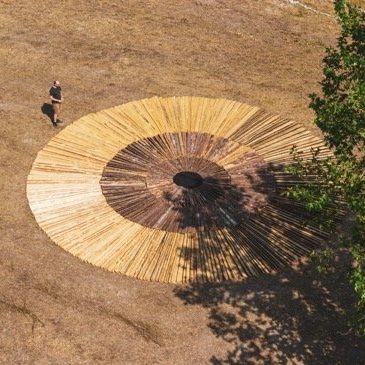
In *Peripheral Memories*, his artistic vision approaches the karst and river landscape not as an inert resource to be exploited, but as a sacred space of coexistence. Through the dialogue initiated by the Cluster Legno Arredo Casa FVG, Mitidieri has combined his architectural vision with the craftsmanship of the local supply chain. The work utilizes “buccioni”—the bark and the roughest, outermost part of the trunk supplied by Domini Legnami—to reclaim the deep connection between the body, natural materials, and the borderland.
Cose di Casa (Participatory Installation at Sagrado): the work is created in-residence in the area from July 5 to 10, 2026. Through a collective workshop led with the young people and girls from Sagrado’s Comfort Zone workshops, Mitidieri erects a structure that explores the archetype of the home as a nest and a protective barrier against the unsettling wild. By weaving together branches, reeds from the Isonzo, and scrap wood, the artist and participants give life to a spontaneous and permeable architecture, leaving a tangible trace in the landscape of the memory of a collective gesture and mutual care.
How to get there: The installation is located on the banks of the Isonzo River opposite the dam, under the Sagrado bridge. To access it, the main landmark to search for on Google Maps is the “Sagrado bridge parking lot.”
On display in Trieste, the genesis and life of the Sagrado installation are depicted through a dedicated documentary video, accompanied by the land art photographs Order is (2018) and Deriva (2021), and by the short films The Essence of Error (a manifesto on the value of symmetry and the repeated gesture as an inner assembly line) and The Heart of the Forest – Metsan Sydamessa.

Yilin Zhu & Matteo Bernardini: Inheritage
A generative sound installation in which artificial intelligence does not replace humans, but acts as an “acoustic microscope.” The work samples industrial noises but, above all, the sounds of the trees surrounding the manufacturing plants. This natural soundscape becomes a constant background note that ideally restores those woodland elements that have historically given way to human development and factories.

Nemanja Milenković: Mrtva Priroda (Still Life)
An environmental installation that deconstructs the conventions of classical still life to cast an ethical and critical eye on the exploitation and waste of natural resources. The work makes this reflection physically tangible through the use of a quantity of sea salt equal to the exact weight of a Friulian deer, inviting the viewer to redefine their relationship with nature and with what we consider waste.

Peripheral Memories 2026 thus takes the form of a living, evolving archive: through the use of wood, charcoal, salt, and generative sound, the artists in the exhibition do not merely document the manufacturing processes of Friuli-Venezia Giulia, but perform an act of giving back to the local community. In an era of transition, where digital automation constantly redefines the boundaries of human action, the exhibition invites us to rediscover the value of the artisanal gesture, of imperfection, and of caring for the living. The works on display— whether created in the silence of an empty factory, on the wild banks of the Isonzo, or in workshops shared with the younger generation — become “nests” of creativity and emotional resilience, reminding us that industry and landscape are not separate worlds, but spaces of coexistence that art can mend and humanize.