Go Design Week!
Fiber Art Exhibition
The diffuse exhibition (the first understanding is exhibited at Carinarnica, Nova Gorica, the second and third at GO! Centre, Gorizia) presents intersectional perspectives investigating the use of fibre art in three different thematic areas, which naturally emerged through a broad and international ‘interrogation of the artistic community’ carried out for the project, precisely to update a state of the art on the most innovative uses and trends of fibre art.
Without claiming to be exhaustive, the complex and controversial phenomenon of the contemporary (between economic exploitation and ecology, between rigid construction and fluid historical narratives, between intersectional phenomena of colonialism and gender) is captured in its multifaceted nature by the artists’ sensitive eye through the textile material and its archetypal implications.
The artists in the exhibition reinterpret the symbols of our time, expressing themselves on some of the hottest topics of contemporaneity.
The new vision, between African renaissances and challenges to the architectures of an intransigent history, criticism of consumerism and evocations of care, is held together by red threads that are stretched by stitching together a memory at risk of extinction, and allows the visitor to come into contact with universal experiences valid in all places on the planet.
CHAPTER 1 – RED THREAD.
@Carinarnica (Nova Gorica)
From Maria Lai to Chiharu Shiota, from Yinka Shonibare to the New Dada contemporaries, from the artists who symbolise the new Native American visual poetics to digital art, dozens of the singers of our time have identified the red thread as an archetypal and universal element, a symbol that brings the observer back in touch with his or her personal experiences of connection.
Be it ‘The red thread of destiny’ (運命の赤い糸, Unmei no akai ito: a popular legend of Chinese origin widespread in Japan, according to which each person carries, from birth, an invisible red thread tied to the little finger of his left hand that binds him to his soul mate) that it is the ‘red thread’ as the binding an element that holds together the scenes of a play or the pieces of a novel, or even whether it is the thread of Ariadne, which leads out of labyrinthine complexes, this powerful visual symbol has often been used by artists as a synonym for ‘stitching’, a cause-effect link and an affective relationship.
It is precisely on the cross-border territory of Nova Gorica-Gorizia, the first European Capital of Culture that intends to mend the urban fabric of two forcibly divided places, that the theme of the red thread becomes a metaphor for change and a pregnant image: it is no coincidence that the Italian-Iranian artistic duo Mestriner & Moslemi worked with the red thread in a collective performance precisely on the border between the two cities, and, as the small but valuable sylloge of works presented in this section shows, the red thread is indeed very present in the imagination of local artists and those who have explored the cross-border and regional territory – it is also found in the works of artists residing in other places in the world with a similar history.
This section of the exhibition brings together a number of contemporary contributions on the theme of the red thread, also drawn from a call for artists dedicated to circulating the contributions of young local and international artists in the enlarged territory of the European Capital of Culture.
MARTA LODOLA (Borgosesia, Italy, 1985, Lives and works in Germany)
COVERED
Performance video work (video, colour, sound, 3 min)
The female body is at the centre of the paradox: the male gaze wants it to adhere to the parameters of the ‘ideal body’ (a model imposed by what sexual attractiveness should be, vigorously stimulated by, among other things, consumer society), parameters which, however, do not correspond to what the body actually is in nature.
By subverting the canon of the pictorial female nude, which has almost always centred on the undressing of women (from Praxiteles, to Roman frescoes, to Titian Venuses, through Impressionism and throughout the 20th century), the artist operates a re-appropriation of her autonomy through dressing.
Aware of the propagation of iconographic power through the ages, Lodola offers us a contemporary version of that Susanna so often undressed and harassed by “vecchioni”.


In his performance, the artist progressively wraps his body with a ball of red wool, charging it with energy and mystical significance: the thread becomes like a second skin, an instrument of elevation towards personal empowerment and a means of de-colonisation from the male gaze.
Lodola reclaims colour as a symbol of paradox: red equals sensuality and danger.
Red wool is a material that has a strong connection with feminine skill: the slow, relentless movement of dressing requires care, patience, determination.
THUTHUKANY MYEZA (Johannesburg, Sud Africa, 1996)
ME AS MY DAUGHTER DEATH + SIGNS OF MOURNING
2023-24, Textile manipulations on vintage photos (collage, wool)
A native Zulu, video-artist and ‘visual historian’, Thuthukany juggles digital collage and manual manipulation of archival photos in what he calls ‘a non-linear process’, which he also sees as a true process of healing from historical trauma.
The exhibition hosts a diptych, composed of two pieces in dialogue with each other: Me as my daughters death, a manipulation on a historical photo that explores how the African woman’s body is still framed by the male gaze as a commodity to be exploited, due to the interconnection of patriarchal phenomena with the colonial legacy.
The image makes clear reference to the abused practices of handcuffing, a colonial legacy still persisting in various places on the continent (not only in post-apartheid South Africa, with widespread severity in the Congo as well), and contains in its title a powerful self-critique of the role of African men in the oppression of the female gender. With her face hidden by the red thread, the artist seems to allude both to the loss of identity of the victim, but also to the need to keep alive the memory of the violent events that have disfigured her country.

The same technique is used to create a digital collage starting from historical photographs from the period 1943-1945 found in the ANPI archive in Udine and kindly provided by the association: the juxtaposition of the female figure with the male one, the language of the body (human on one side, regimented on the other) clarifies the artist’s perspective, which gives women the role of divergent interpreters of the oppressive historical fact.
The artist, assisted by historian Federico Tenca Montini, completed his ‘digital residency’ in Friuli Venezia Giulia in June this year, and the new piece will be on show in the exhibition as a preview.
TAMARA MIHALIČ (Koper, Slovenia, 1995)
2025 – Artwork produced in residence for GO! DESIGN WEEK
Red wool, aluminium, digital fluctuations
A visually representative relationship between the fluctuation of crypto-currencies and the trends of contemporary history: this is Tamara Mihalič’s material research, which during her residency in Gorizia-Nova Gorica the artist composed through spatial and sensory exploration methods of the GO! 2025 territory.
The result is an ‘imaginary landscape’ descriptive of the cross-border territory and its fluctuating historical trends, which are often difficult to ‘hold together’ and visualise: the red woollen thread, in this case, becomes an element that makes the passages of history manifest.

The work is part of that strand of visual research that addresses and materialises the theme of the digital in the material: among these, some, particularly relevant and ahead of their time, were shown in the famous ‘Talk To Me’ exhibition at MoMA (New York in 2011).
CHAPTER 2 – Memory and Production. For an organic rebellion between cross-border territory and the African renaissance
@Go! Center (Gorizia)
Square architecture from the fascist period coexists with elaborate Viennese stuccos and Brutalist echoes in the cross-border and regional area.
The physical structure of our towns and its man-made landscapes tell a story of not always democratic moments: the Karst landscape is dotted with burial sites, and that of the surrounding region with industrial archaeologies that testify to the border industrialisation and militarisation that followed, tying in with the totalitarian regimes that affected the border area.
In the small and precious selection of works hosted in this session of the exhibition, projects and works on the theme, created by artists who have worked in the area, outline a clear polarity between the rigid and massive ratio of over-production (both of architectural constructions and industrial processes) and the organic and perishing logic of the environment and ecology. The projects also present a high quotient of research and collaboration with citizenship and with the realities that in the area deal with the issue of textile production – from companies that use recycled materials to produce textiles, to farms that cultivate the raw materials – enhancing the cultural and natural heritage of the area.
A parallelism is drawn with the role of fibre art in the contemporary African scene: drawing on the innovative voices of the ‘African Renaissance’, the exhibition proposes works and video testimonies that release all their symbolic charge into space, above all by resorting to the intersection of the language of videography with that of textiles.
It is in this way that fibre art becomes a pivotal tool to de-colonise artistic expression and to soften with organic traits the often rigid -architectural and thought- structures that have characterised the 20th century.
Criticism of fast-fashion production practices – urgently felt in Africa and felt as worrying in our area – emerge as points of commonality and, even more precious, poetic evocations surface, suggesting alternative solutions and new interpretations for the world of textiles.
INÊS COELHO DA SILVA (1996, Portugal)
RETRATO (vão, indo, indo, indo)
2020, material installation (recycled microfibre, wood, thread, peppercorns)
Inês Coelho da Silva carried out her artist residency in October 2020 in the area of Bassa Friulana and Goriziano, producing an unprecedented work of art in collaboration with the companies Abitex and Miko Srl.
Invited to research the textile industry in the area, the artist visited Torviscosa – a former Fascist company town where cellulose was first produced for textile use, and then in the 1960s caprolactam, the raw material for nylon fibres and threads – while observing the innovative ways in which contemporary industry processes textile fibres today.


In his final work, fabrics supplied by the Gorizian company Miko, a manufacturer of recycled microfibre, flow as softly as the history of the border area, supported by a wooden structure that recalls the architecture of Torviscosa. A closer look reveals that the entire system is supported by two peppercorns tied with white thread: they perhaps symbolise the industriousness of the inhabitants – according to the artist, in fact, ‘black pepper sustains many local dishes in the same way that people sustain the life of their towns, so invisible, yet so important’.
THURAKELLA EDITHA GYINDO (1996, DAR ES SALAAM, TANZANIA)
THE SONG OF WATERS
2024, video art/video installation, 1 minute 30 seconds (Swahili, English, Kinga), Videographer: Emmanuel Gyindo
Inspired by human nature and its adaptation to the new, changing world, the artist questions the collective preconception of productivity, along with the colonial influence that transported him to Africa, working intersectionally on identity and belonging, new forms of architecture and textiles.

The video work The Song of Waters is a manifesto of his thinking, linking the textile medium to nature and its processes, providing a perceptive backdrop to the works in the exhibition.
DAMIEN AJAVON (1990)
BLACK CRAFT MATTERS
2023, Photo series and retrospective videographic material
Artist and designer, originally from Senegal and Togo, who moved to Scandinavia, where, through his connection with textile art, he recovered precious elements of identity: a fluid identity, incorporating African traditions and elements of experience typical of the new context, which precisely through textile art find a point of union.

In the short video and photographs, the artist recounts the inscribed value of his practices for the enhancement of African identity in the diaspora.
WORKSHOPS, TALKS, LABORATORIES, SPECIAL EVENTS: A CALENDAR OF PARTICIPATORY EVENTS ON FIBRE ART
Monday 10 March 2025 @Atelier creativo di Fogliano Redipuglia
CREATIVE WORKSHOP FOR GIRLS AND BOYS 11+
With Thurakella artist Editha Gyindo and Comfort Zone art therapists
Inspired by human nature and its adaptation to the new, changing world, Editha questions the collective preconception of productivity, along with the colonial influence that transported it to Africa, working intersectionally on identity and belonging, new forms of architecture and textiles.

Starting from the meeting with the artist, the young participants will experience his practices between textile art in contact with the local natural context.
Tuesday 11 March 2025 @Atelier creativo di Mariano del Friuli
Vintage or Violence CREATIVE LABORATORY FOR GIRLS AND CHILDREN 11+
With the artists/activists Sedi Oluko Moche & Nikissi Serumaga (Uganda), and the art therapists of Comfort Zone
A multimedia project exploring the intersections between colonialism and waste production in the textile – fast-fashion sector, framed from a pan-African perspective, which aims to ‘deconstruct, through textiles, the ways in which we are used to thinking and evolving in a colonial way’.
Where does the vintage end and the violence begin?

An engaging, witty and informative narrative that deconstructs and explains the complexity of textile waste and its impacts on Africa, taking the system as an example of how it affects Uganda, the home country of the activists/artists: Western countries can dump all their used clothes in Uganda, as a matter of policy and custom. But Uganda, in parallel, although characterised by a textile design renaissance, cannot export clothes without heavy and unbalanced tax implications!
In the workshop, elaboration of themed photographs, podcasts and videos, to critically and self-referentially chart the course of one’s own textile consumption in the family and community.
Thursday 13 March 2025 @Creative workshop in San Pier d’Isonzo
The red thread of ‘visual history
CREATIVE WORKSHOP FOR GIRLS AND BOYS 11+
With artist Thuthukani Myeza the Comfort Zone art therapists
A native Zulu, video-artist and ‘visual historian’, Thuthukany juggles digital collage and manual manipulation of archival photos in what he calls ‘a non-linear process’, which he also sees as a true process of healing from historical trauma.

Starting with an encounter with the artist, the young participants will experience his practices between textile art, personal and collective history.
Friday 14 March 2025 @Atelier creativo di Capriva del Friuli
CREATIVE WORKSHOP FOR GIRLS AND BOYS 11+
With artist and designer Damien Avajon
An artist and designer, originally from Senegal and Togo, he moved to Scandinavia, where, through his connection with textile art, he recovered precious elements of identity: a fluid identity, incorporating African traditions and elements of experience typical of the new context.

The artist will meet with the working group, recounting the inscribed value of his practices for the enhancement of African identity in the diaspora, and Comfort Zone art therapists will help participants in the direct experience of Damien’s artistic practices.
On Saturday 15 March 2025, for the finissage of the exhibition, a cognitive itinerary and guided tour between Gorizia and Nova Gorica:
@ Carinarnica venue for the ‘Read Thread’ exhibition
9 a.m. to 5 p.m.: Free guided tours with Tamara Mihalič, artist in residence
(for the whole family – usable in several languages)
Free event with prior booking, small groups welcome.
@ GO! Centre – in the courtyard (in case of rain: Kubo Hall 1st floor)
10.30: “Breakfast with the artists!” / Ripening
A CONVERSATION FOR BREAKFAST, WITH ARTISTS VITA IVIČIĆ (NOVO MESTO, SLOVENIA, 1990) AND MATEJA KAVČIČ (1970, NOVO MESTO, SLOVENIA)
(event for the whole family – available in several languages)
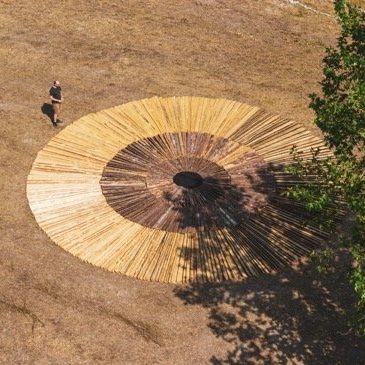
The space installation Ripening (2022) reminds us that without solar energy, there would be no textiles and, consequently, no clothes made from natural materials: in the past, these were the key to the survival and development of mankind (everything would have suggested that in terms of weaving practices, we would follow the example of our ancestors, but instead…).
The work combines the ecological concept with the idea of impermanence and transience.

The floor of the work is made of wooden ‘pegs’ that have been exposed to the weather for many years, the hand-spun linen threads represent the sun’s rays, and were grown in the fields of the White Carpathians in the summer of 2022, in cooperation with the Razstresen farm in Rome and the Kolpa Park Landscape (reviving the traditions of home-made linen production and respect for the ethnographic and cultural heritage of the Belokranjska region, more than 80 citizens participated).
This event is free of charge, suitable for all ages and available in several languages. Reservations are recommended in order to participate: godesignweek2025@gmail.com
During the lunch with the artists, interviewed by Zala Orel, curator of BIEN – Biennial of Textile Art in Kranji, a story will be told about the project, in dialogue with the participants.
There will also be a preview of the next events of the BIEN project, the official project of the Bid Book of GO! 2025
@ GO! Centre – in the courtyard (in case of rain: Kubo Hall 1st floor)
9 a.m. to 1 p.m.: ‘Threading & REPAIR-A-THON’ with Saša Nemec
A COLLECTIVE MENDING ACTION (for the whole family – available in several languages)
Threading, repairing: an action that explores how collaborative art practices, when guided through a feminist-flavoured lens of care, can inform and open up new shared reflections.

For the finissage of the exhibition, citizens are called upon to do something concrete, participating in an unprecedented collective interaction: encouraged to bring their own objects to repair or mend them for free in the courtyard of the Go! Centre, where the artist-activist will be waiting for them with needle, thread, sewing machine, conversations on ecology, videos and digital renderings.
A ‘free repair event’ where the act of mending is transformed into a community art practice that brings out personal stories, emotions and perhaps even changes of mindset.
This event is free, suitable for all ages and available in several languages. Reservations are recommended in order to participate: godesignweek2025@gmail.com